Through a variety of approaches, including CLEP (American History II), AP credit from high school (American History I), a course transferred from a local community college (World History II), and three courses online at SNHU (World History I, Modern War and Society, and Making History), I have completed half of the courses in the history major at SNHU, with six more to go. Since I intend to focus on 20th century Europe, the courses I have left to take are courses on World Wars I and II, Modern Europe 1890 to Present, and Modern Russia. The final two courses are a thesis-writing course and an elective -- right now, I'm thinking I'll take a graduate-level research course for the elective, but that's a year away now.
My tuition remission perq requires that I take no more than four courses per year (unless I pay for them). So as not to violate that limit, I cannot take a course again until April 11, when I intend to take the course on Modern Russia. In preparation for that course, in which I intend to focus on the Great Purges, I have been reading fairly broadly in that area, including Conquest's The Great Terror and now on to J. Arch Getty's Origins of the Great Purges and a relatively recently published translation of the Ryutin Platform. More on that topic as my ideas develop.
Finally, I'll be spending the next few weeks writing up some material from the Nazi occupation of Latvia and the liquidation of the Jewish ghetto established at Riga in November and December 1941, the subject of some controversy in the historical community. I will post that material both here and at Holocaust Controversies, hopefully in the next few days.
Other Stuff I'm Reading
Universal Fascism: The Theory and Practice of the Fascist International, Michael Ledeen
The Anatomy of Fascism, Robert O. Paxton
Saturday, February 6, 2016

Saturday, January 30, 2016
Meritocracy: A Mongol Innovation
Of the many innovations introduced to other parts of the world by the Mongols, as they invaded neighboring regions and established their empire, meritocracy is among those with the greatest impact over time. Meritocracy, quite simply, is defined as "a system in which the talented are chosen and moved ahead on the basis of their achievement."[1] Before the rise of meritocracy, advancement in positions, whether military, political, or economic, was based on nepotism or personal favoritism. With the Mongol concept of meritocracy, family ties were overridden by advancement based on proven ability.[2]
Arguably, this attention to merit rather than bloodlines was among the decisive factors rendering the Mongols so efficient and fearsome on a military basis. The Han Chinese general Guo Kan offers a paradigmatic example. Guo Kan, despite being a member of an army that resisted the Mongols, was promoted under Kublai Khan and assisted the Mongols in subsequent victories. For instance, in describing the Mongol victory over the Abbasid Dynasty, historian Frank McLynn writes that Guo Kan was "at 40 the same age as Hülegü [grandson of Genghis Khan] and already renowned as an example of the way Mongols promoted on merit rather than birth."[3]
The idea that position should be determined by merit and not by birth continues to the present day. Our own U.S. military promotes on that basis, for instance, as do virtually all other militaries. And while nepotism might remain an issue in some sectors, it has nevertheless become axiomatic that hard work pays off and that the best way to the top is through one's hardest effort.
=====
1. Merriam-Webster Dictionary, "meritocracy," accessed January 14, 2016, http://www.merriam-webster.com/dictionary/meritocracy
2. Paula L. W. Sabloff, Modern Mongolia: Reclaiming Genghis Khan (Philadelphia: University of Pennsylvania Press, 2001), 99-100.
3. Frank McLynn, "Mongols at the Gate," Military History, 32 (September 2015): 41.
2. Paula L. W. Sabloff, Modern Mongolia: Reclaiming Genghis Khan (Philadelphia: University of Pennsylvania Press, 2001), 99-100.
3. Frank McLynn, "Mongols at the Gate," Military History, 32 (September 2015): 41.
Sunday, January 24, 2016
Term Paper: Arab Rule in Sicily
By 732 CE, the armies of the Umayyad
Caliphate, with their conquest of the Iberian Peninsula well under way, had
crossed the Pyrenees only to be defeated in France by Charles Martel at the
Battle of Tours. With only 250 kilometers between Carthage in North Africa and
the western Sicilian city of Trapani and just eight kilometers from Messina on
the northeast corner of Sicily to Reggio di Calabria on the toe of Italy’s
boot, it might seem that Sicily would be the ideal route through which Muslim
armies from Ifriqiya could attack what Winston Churchill once called the “soft
underbelly” of Europe. However, it was another hundred years before the
military of the Aghlabid dynasty in Ifriqiya invaded Sicily in 827 and
eventually established an emirate there. Over the next two and a half centuries
between this invasion and the conquest of the island from the mainland by the
Normans in 1071, Arab Muslims exercised at least partial, but often total,
control over Sicily. Despite this comparatively brief period of Arab-Muslim
rule, the period had enormous economic, political, and cultural consequences
for the island, many of which persisted long after the Arabs were gone.
Because of its geographic location at
the center of the Mediterranean and the ability to sail there from Carthage in
a matter of days and from there to Reggio in only hours, Sicily has played an
enormous strategic role for all governments that have held it. Aside from its
obvious military importance, because of Sicily's temperate climate, this role
has been chiefly economic and principally agricultural. Under Roman rule, the
island had served as a breadbasket for other areas, producing wheat that was
largely exported elsewhere.[1]
Following periods of Vandal and Gothic occupation, the Byzantine Empire
extended its rule over Sicily in the mid-sixth century CE, during which period
the island largely continued to play this important economic/agricultural role,
particularly after the loss of Egypt to the Muslims in 641 and the long embattled
state of Anatolia through the ninth century. In addition, a mint was
established at Syracuse in the 640s.[2]
With the establishment of Arab control,
these roles necessarily changed. Perhaps in contrast with expectations,
although military conflict hampered trade at times, Sicily nevertheless
continued to serve as an important economic crossroads, both in terms of
currency and agriculture. First, Sicily's role in the production of currency
continued during the Arab period. British historian Alex Metcalfe notes that
the Arab minting of coins began almost immediately, noting, "the first
coinage with the Arabic legend Ṣiqilliyya
were struck at the siege of Castrogiovanni as early as 829 and, within four
years of the fall of Palermo, the first coins bearing the name of its governor
are attested."[3]
Metcalfe reports further that, although the Aghlabid dynasty failed to establish
use of the gold dinar in Sicily, the later Fatimid dynasty that ruled the
island successfully circulated the tari,
with the coin remaining in circulation both on Sicily and the mainland for
centuries to follow.[4]
More importantly, agriculture in Sicily
expanded tremendously under Arab rule. The economist Andrew M. Watson has
described an Arab "agricultural revolution" that impacted the
economies all of area occupied by the Arabs, Sicily included. Watson records a
total of sixteen food crops, as well as cotton,[5]
and he suggests that the implanting of crop species from warm Arab climates
into areas such as Sicily resulted in longer growing seasons with more abundant
yields.[6]
The introduction of diversification among crops resulted in greater choice
among landowners and farmers for how land could be used.[7]
Finally, innovations by Arabs to irrigation systems resulted in cotton being
grown on some of the previously worst land in Sicily, and Watson writes that
"we may assume that this crop also helped to push back the frontier of
sedentary agriculture."[8]
Today, several important exports from Sicily, including lemons and cotton, come
from crops introduced during the Arab period, and wheat continues to be
produced there.[9]
From a political perspective, as already
noted, the key change that occurred in the ninth century CE was that political
control passed from Byzantine to Arab hands. In some ways, there is perhaps no
more emblematic way to examine this change than to compare the roles of
Sicily's two main cities -- Syracuse on the eastern coast and Palermo in the
northwest -- during the period under discussion. In the seventh century, the
Byzantines elevated Sicily to the status of a theme -- the chief administrative
division of the empire -- and Emperor Constans II moved his imperial court to
Syracuse as well, using the city as a base to raid Lombard-held areas of Italy.
Until its fall to the Arabs in 878, Syracuse remained the capital of the theme.[10]
However, Metcalfe reports, "Much of the material infrastructure of Syracuse
itself – its walls, churches and houses – was damaged, and the city was
stripped of its transferable wealth in two months of post-conquest
looting."[11]
Comparatively speaking, Palermo, then
known as Panormus, seems to have become something of a backwater in the late
Byzantine period, despite its earlier role as an important port. The French
historian Vivien Prigent has argued that Palermo initially witnessed an
increase in importance among Sicilian cities but that it eventually was
eclipsed by other cities in the northwest of Sicily and never grew in size or
importance such that it became necessary to replace the ancient Punic walls
around the city with sturdier defenses.[12]
Because it fell earlier than Syracuse, the Arabs established their capital in
Palermo. The evolution of the capital city over a one hundred-year period is
perhaps demonstrated by comparing eyewitness accounts of the city.
The first, from 880 CE, is a letter from
Theodosius, a Greek monk residing in Syracuse, to Leo, an archdeacon of the
Christian church, detailing an eyewitness account of the Arab conquest of
Syracuse after decades of sporadic sieges and raids. From Syracuse, Theodosius was
brought as a slave to Palermo, which he describes as an "extremely famous
and populous city,"[13]
in which multiple ethnicities intermingled both freely and in the prisons. He
commented further, "Wherefore the people being crowded together in such a
press of inhabitants, began to build and inhabit houses without the walls, to
such an extent that they really built many cities round the original one, not
unequal to it, if one choose, either for attack or defence [sic]."[14]
Clearly in the short period between the fall of Palermo and Theodosius's visit,
the city had already crown in size and importance.
The second account of Palermo dates from
972 CE, by which point the city had grown even more. The author, Ibn Hawqal, an
Arab cartographer born in present-day southern Turkey who wrote a book about
his travels, wrote that Palermo "consists of five quarters, each one close
to the others, but situated in such a way that the borders of each are clearly
defined. The largest quarter … is enclosed by a high defensive stone wall and
inhabited by merchants." Beyond the city now extending to five quarters,
all of which Ibn Hawqal describes in some detail, it is also clear that the
city had grown sufficiently in importance that it was now defended by more
substantial walls. In the outlying areas of the city, Ibn Hawqal reports the
presence of more than two hundred mosques, stating, "I have not heard
anything like it except what they say about Cordova [in Spain]."[15]
In fact, regarding the city walls, Ibn
Hawqal specifically describes the city quarter called Al-Khalisa, known today
as Kalsa, nothing that it "has a wooden wall which is not like the stone
wall that surrounds the Old City."[16]
Metcalfe dates the building of this city quarter to the reign in Palermo of
Khalil ibn Ishaq, an army commander sent by the Fatimids from Cairo to restore
order during a period of strife.[17]
This same Khalil was responsible for tearing down the earlier walls. In the
"Cambridge Chronicle," an anonymous history of Sicily written in the
tenth or eleventh century, it is reported that, on October 13 of either 937 or
938, Khalil "entered [Palermo] with large numbers of troops and began to
raze the walls of [Palermo] and pull down its gates."[18]
Metcalfe finally reports the walls being further fortified in 967.[19]
The walls to which Ibn Hawqal bore witness five years later were, it turns out,
perhaps quite new.
Clearly, Palermo's role as capital city
of Sicily, which it remains today, was the direct outgrowth of the transition
from Byzantine to Arab rule. However, it bears mention that Arab control of
Sicily encompassed several different governments, in the forms of caliphates
and dynasties, between the eighth and eleventh centuries. The Aghlabid dynasty,
based in Carthage in North Africa (Ifriqiya), was the power that first invaded
Sicily in 827 and secured control over the whole island. However, in 909, the
Aghlabids lost Ifriqiya to the Shia Fatimid Caliphate based in Egypt. In 948,
the Fatimids appointed the Kalbid dynasty to rule Sicily. In 973, the Fatimids installed
the Zirid dynasty in Sicily, which ruled the island until 1053, at which point
central control broke down. Eight years later, the Norman conquest of Sicily
began.[20]
More momentous than either the economic
or political changes that Sicily experienced between the eighth and eleventh
centuries were the cultural shifts that occurred there. These changes can be
best understood through the lenses of religion and language. From the
standpoint of religion, Sicily underwent with the Arab invasion the obvious
infusion of a Muslim population in what was formerly a Christian population
with a small Jewish minority. The standard imposition of rule of Christians and
Jews by Muslims would involve the imposition of the status of dhimmi, with the requirement payment of
certain taxes and limited toleration. This type of rule was imposed over the
western portion of the island, and a large number of former Christians also
converted to Islam. However, in the eastern portion of the island, which both
was more difficult to conquer and lay in closer proximity to the Italian
mainland, the status of Christians ranged from dhimma to the requirement of tribute payments to de facto
independence.[21]
Long-term truces between the Byzantine Empire and the Muslim rulers of Sicily
facilitated such a status quo.
Linguistically, the effects of
Arab-Muslim rule were longer, persisting to the present day. The Romans had
established the speaking of a Romance language in Sicily, but as the Byzantines
took control, Greek slowly began to be established as a common spoken language.
Quite obviously, the Arab invaders spoke Arabic. Today, the language spoken in
Sicily is a Romance language that demonstrates a marked Arabic influence. For
instance, Berkeley professor of Romance Languages Barbara De Marco has argued
that the contemporary Sicilian term for a simpleton -- mamaluccu -- is cognate with the Arabic word for a slave – mamluk.[22]
Similarly, Metcalfe has demonstrated how several Sicilian town names, including
Calatrasi and Calatafimi, are formed in part from the Arabic word for a fort --
qal'at.[23]
These examples supplement the previous instance of the Al-Khalisa section of
Arab Palermo, now known Kalsa.
Clearly, the impact of the Arab invasion
and conquest of Sicily beginning in the ninth century C.E. had monumental
effects on the island. In addition to the political shift from Byzantine to
Islamic political control, the economic role of Sicily as granary and mint to the
surrounding areas expanded greatly. From a cultural standpoint, the effect was
arguably the greatest, with a large-scale religious metamorphosis among the
population lasting centuries but the linguistic effects of the conquest
persisting to the current day. While the Arab-Muslim impact on Spain is perhaps
better known today due to its longer duration, the impact of the Muslim world
on Sicily was also quite profound.
[1]
This epithet for Sicily (together with North Africa and Sardinia) seems to
originate in Cicero's Pro Lege Manilia
34: "He [Cnæus Pompeius], when the weather could hardly be called open for
sailing, went to Sicily, explored the coasts of Africa; from thence he came
with his fleet to Sardinia, and these three great granaries of the republic he
fortified with powerful garrisons and fleets." Translated by C.D. Yonge,
Perseus Digital Library, accessed November 28, 2015,
http://www.perseus.tufts.edu/hopper/text?doc=Perseus%3Atext%3A1999.02.0019%3Atext
%3DMan.%3Achapter%3D12%3Asection%3D34
%3DMan.%3Achapter%3D12%3Asection%3D34
[2]
Michael F. Hendy, Studies in the Byzantine
Monetary Economy c. 300-1450 (Cambridge, United Kingdom: Cambridge
University Press, 2008), 421-422.
[3]Alex
Metcalfe, The Muslims of Medieval Italy
(Edinburgh, U.K.: Edinburgh University Press, 2009), 13.
[4]
Ibid, 63-64.
[5]
Andrew M. Watson, "The Arab Agricultural Revolution and Its Diffusion,
700-1100," Journal of Economic
History, 34 (1974): 9.
[6]
Ibid, 10
[7]
Ibid, 14
[8]
Ibid, 15
[9]
Jack Altman, This Way Sicily (Lausanne,
Switzerland: JPM Publications, 2002), 3.
[10]
Thomas S. Brown, "Byzantine Italy (680-876)," in The Cambridge History of the Byzantine Empire, c. 500-1492, edited
by Jonathan Shepard, 433-464. (Cambridge, United Kingdom: Cambridge University
Press, 2008), 436-437.
[11]
Metcalfe, ibid, 28.
[12]
Vivien Prigent, "Palermo in the Eastern Roman Empire," in A Companion to Medieval Palermo: The History
of a Mediterranean City from 600 to 1500, edited by Annliese Nef (Boston:
Brill, 2013), 11-38.
[13]
Theodosius of Syracuse to Leo Diaconus, 880 C.E., Quoted in Francis Marion
Crawford, The Rulers of the South, 2
vols. (London: MacMillan & Co. Ltd., 1900), chapter 2, University of
Chicago Web site, accessed November 23, 2015,
http://penelope.uchicago.edu/Thayer/E/Gazetteer/Places/Europe/Italy/_Texts/CRAROS/2/2*.html
[14]
Ibid.
[15]
Ibn Hawqal, Excerpt from Book of the
Traditions of Countries, 972 C.E., Translated by William Granara, "Ibn
Hawqal in Sicily," Alif: Journal of
Comparative Poetics, 3 (1983): 95.
[16]
Ibid.
[17]
Metcalfe, ibid, 50.
[18]
Taʾrīkh Jazīrat Ṣiqilliya [History of the Island of Sicily, also
known as The Cambridge Chronicle],
circa 10th or 11th century C.E., MSS in the Cambridge University Library
(Arabic text), United Kingdom, translated by Alex Metcalfe, who kindly provided
his unpublished translation of this material for use here.
[19]
Metcalfe, ibid, 56.
[20]
Ibid, xi-xvii.
[21]
Ibid, 106-108.
[22]
Barbara De Marco, "The Sounds of Change: Arabic Linguistic Influences in
Sicily," in Georgetown University
Round Table on Languages and Linguistics 1988, edited by Thomas J. Walsh
(Washington: Georgetown University Press, 1989), 94-101.
[23]
Metcalfe, ibid, 36.
Thursday, January 21, 2016
Two Buddhas
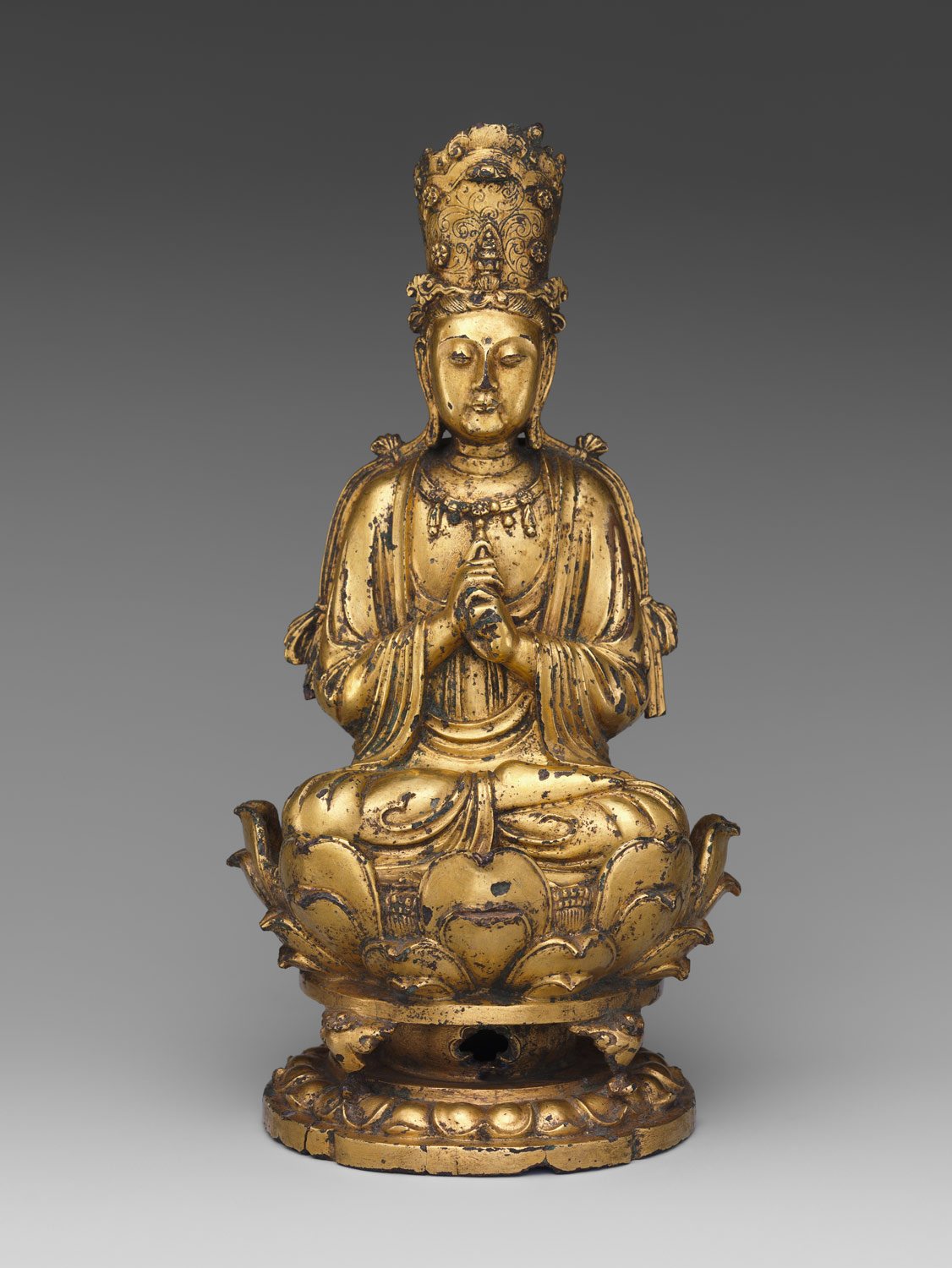
For religions with long histories and large numbers of adherents, history can often have a significant impact on the way in which the faith is practiced. Whether Sunni or Shia powers were the first to extent control over a non-Islamic area, for instance, might have determined whether that population is Sunni or Shia right down to the present day. Similarly, the languages of the liturgies of Christian churches largely reflect their places of origin. The same general rule held true for Buddhism as it began and subsequently spread, via the Silk Road, across Asia. A comparison of Buddhist art from different times and places affords an opportunity to see such differences.
The earlier sculpture, from approximately 250 CE in current-day Pakistan, bears the characteristics of Hinayana or Theravada Buddhism and its emphasis on sacrifice. The sculpture shows Siddhartha so emaciated that his ribs are showing, presumably as the result of extended fasting. The base of the sculpture shows monks sitting, indicating the sort of person most attracted to this variety of Buddhism; given the emphasis on the Hinayana tradition on self-deprivation, monks who devoted their lives to the practice of the religion would make up a majority of the adherents. Finally, the sculpture is made of stone, indicating modesty in terms of material wealth.[1]
In contrast, the later statue, from China during the Tang Dynasty (7th to 10th century CE), reflects Mahayana Buddhism, the "greater vehicle" by which Buddhism was successfully introduced to the masses. Compared to the starved Buddha from 250 CE, the Tang Buddha has a normal build, perhaps indicating for adherents a secular station in life as opposed to one of monastic self-denial. Instead of being surrounded by monks, the Tang Buddha is alone, indicating to the viewer that s/he could also attain enlightenment. Finally, and perhaps most importantly, the Tang Buddha is made of gold rather than plain stone, indicating that the Buddhist can enjoy economic wealth in addition to (or perhaps despite) his/her religion.[2]
===
1. Jerry Bentley and Herbert Ziegler, Traditions and Encounters, Volume 1: To 1500, 3rd ed. (New York: McGraw-Hill, 2012), 128.
2. Ibid.
The earlier sculpture, from approximately 250 CE in current-day Pakistan, bears the characteristics of Hinayana or Theravada Buddhism and its emphasis on sacrifice. The sculpture shows Siddhartha so emaciated that his ribs are showing, presumably as the result of extended fasting. The base of the sculpture shows monks sitting, indicating the sort of person most attracted to this variety of Buddhism; given the emphasis on the Hinayana tradition on self-deprivation, monks who devoted their lives to the practice of the religion would make up a majority of the adherents. Finally, the sculpture is made of stone, indicating modesty in terms of material wealth.[1]

In contrast, the later statue, from China during the Tang Dynasty (7th to 10th century CE), reflects Mahayana Buddhism, the "greater vehicle" by which Buddhism was successfully introduced to the masses. Compared to the starved Buddha from 250 CE, the Tang Buddha has a normal build, perhaps indicating for adherents a secular station in life as opposed to one of monastic self-denial. Instead of being surrounded by monks, the Tang Buddha is alone, indicating to the viewer that s/he could also attain enlightenment. Finally, and perhaps most importantly, the Tang Buddha is made of gold rather than plain stone, indicating that the Buddhist can enjoy economic wealth in addition to (or perhaps despite) his/her religion.[2]
===
1. Jerry Bentley and Herbert Ziegler, Traditions and Encounters, Volume 1: To 1500, 3rd ed. (New York: McGraw-Hill, 2012), 128.
2. Ibid.
Thursday, January 14, 2016
Conversion in Late Antiquity: Islam v. Christianity
Christianity and Islam are closely related religions, with the key differences between focusing mainly on their different understandings of Jesus and the latter's emphasis on the prophesies of Muhammad. Although they are not the only Abrahamic faiths, they nevertheless spread rapidly in the century or two following their founding, and through today, their adherents make up almost half of humankind. The key aspect that they share, other than a clear belief in the same supreme being, is that they are both salvation religions, teaching that through a combination of belief and right conduct, human beings can obtain eternal life in Heaven after their physical life ends. Although this message was popular in late antiquity, there were other salvation religions that were ultimately less popular. Christianity and Islam were both successful, therefore, for reasons other than the message of salvation, but the most vital factors were actually for their individual successes were quite different.
Christianity was spread among people other than Jews, from among whom it originated, primarily through the ministry of St. Paul. Paul was a Jew from Tarsus in modern-day Turkey, but he held Roman citizenship, which he used to travel more freely than other people living under Roman rule might have. This freedom of movement significantly facilitated the success of St. Paul's ministry. In addition, St. Paul, as well as the other first-generation leaders of the Christian church, spoke Greek as at least a second language if not their primary language; much of the Middle East and all of modern-day Turkey was Greek-speaking since its Hellenization by Alexander the Great. The dissemination of the Christian message in as widespread a language as Greek also greatly facilitated the spread of Christianity. Finally, once the Roman Emperor Constantine adopted Christianity as Rome's state religion in the early fourth century, Christianity benefited enormously, not only from the elimination of Roman persecution of Christians, but also because the spread of Christianity could subsequently benefit from Roman political authority, resources, and trade routes.[1]
Islam seems to have benefited most in its initial period from the Muslim concept of jihad, or struggle. Although theological interpretation of the term has varied greatly over the 1,400-year history of Islam, it is relatively clear that, in this vital first period, during which Islam spread enormously, jihad entailed the spreading of the Islamic faith through force. Certainly, it is unquestioned, including by Muslims themselves, that Muhammad spread Islam from Medina to Mecca by the sword. As the Muslim world expanded, jihad worked hand in hand with less militant methods, including the offering of economic incentives to countries accepting Islamic rule, if not the Islamic faith itself. Although most communities that came under Muslim rule became Muslim themselves, small communities of Jews, Christians, and Zoroastrians enjoyed protected minority status under Islamic rule in exchange for the payment of a poll tax. This policy assured the continued spread of Islam by the consolidation of political authority without the need to forcibly convert subject populations.[2]
======
[1] Jerry Bentley and Herbert Ziegler, Traditions and Encounters, Volume 1: To 1500, 3rd ed. (New York: McGraw-Hill, 2012), 153-154.
[2] Ibid, 198-204.
Christianity was spread among people other than Jews, from among whom it originated, primarily through the ministry of St. Paul. Paul was a Jew from Tarsus in modern-day Turkey, but he held Roman citizenship, which he used to travel more freely than other people living under Roman rule might have. This freedom of movement significantly facilitated the success of St. Paul's ministry. In addition, St. Paul, as well as the other first-generation leaders of the Christian church, spoke Greek as at least a second language if not their primary language; much of the Middle East and all of modern-day Turkey was Greek-speaking since its Hellenization by Alexander the Great. The dissemination of the Christian message in as widespread a language as Greek also greatly facilitated the spread of Christianity. Finally, once the Roman Emperor Constantine adopted Christianity as Rome's state religion in the early fourth century, Christianity benefited enormously, not only from the elimination of Roman persecution of Christians, but also because the spread of Christianity could subsequently benefit from Roman political authority, resources, and trade routes.[1]
Islam seems to have benefited most in its initial period from the Muslim concept of jihad, or struggle. Although theological interpretation of the term has varied greatly over the 1,400-year history of Islam, it is relatively clear that, in this vital first period, during which Islam spread enormously, jihad entailed the spreading of the Islamic faith through force. Certainly, it is unquestioned, including by Muslims themselves, that Muhammad spread Islam from Medina to Mecca by the sword. As the Muslim world expanded, jihad worked hand in hand with less militant methods, including the offering of economic incentives to countries accepting Islamic rule, if not the Islamic faith itself. Although most communities that came under Muslim rule became Muslim themselves, small communities of Jews, Christians, and Zoroastrians enjoyed protected minority status under Islamic rule in exchange for the payment of a poll tax. This policy assured the continued spread of Islam by the consolidation of political authority without the need to forcibly convert subject populations.[2]
======
[1] Jerry Bentley and Herbert Ziegler, Traditions and Encounters, Volume 1: To 1500, 3rd ed. (New York: McGraw-Hill, 2012), 153-154.
[2] Ibid, 198-204.
Monday, January 11, 2016
Greece, Rome, Democracy
Although the Constitution of the United States borrowed from both Athenian democracy and the Roman Republic, I believe that, while Athenian democracy more closely resembles what most people think of when they consider democracy, the U.S. Constitution, particularly in its original form, more closely resembles the Roman Republic, particularly with regard to the institutions established to govern and the manner in which the people obtained representation through these institutions.
Ancient Athens operated on a model of direct democracy, in which the people regularly participated in aspects of governance, including legislation and trial by jury. In this regard, it differed significantly from the United States, which operates on a model of representative democracy, in which deputies are elected to represent constituencies of citizens every two years (although some states, notably California, in implementing extensive plebiscite systems, have adopted aspects of direct democracy). Regarding participation, only between 10% and 25% of the Athenian population -- consisting entirely of free, property-owning, adult men -- could participate. In this regard, Ancient Athens perhaps most closely resembled the early U.S., in which it was also true that only free (i.e., white), property-owning, adult men (21 years old) could vote.[1]
The Roman Republic, in contrast, endowed the greatest power in the Senate, which was a legislative body whose members were appointment by the consuls (the executive powers of the state), who in turn were elected by the patrician class, who in turn were the descendants of the original 100 members of the Senate. In this fashion, the Senate was a sort of closed society with a feedback loop of power concentrated in the hands of around 5% of the population. Eventually the plebian class was enfranchised through the creation of its own legislative assemblies and the office of tribune, although the Senate retained more power.[2]
In these regards, i.e., separation of executive and legislative power and a bicameral legislature with power unevenly distributed, the resemblance between the Roman Republic and the U.S. is clearest. However, the Athenian system is closer to what most people would regard as democracy. Neither had anything close to resembling universal suffrage, but the direct participation of citizens in Ancient Athens and the greater equality among citizens without regard to class seem more democratic. In particular, because of its direct democracy, Ancient Athens actually seems more democratic than the U.S. today, in part because the U.S. is more a republic than a democracy.
=====
1. Mark Cartwright, "Athenian Democracy," Ancient History Web site, accessed December 12, 2015, http://www.ancient.eu/Athenian_Democracy/
2. Jerry Bentley and Herbert Ziegler, Traditions and Encounters, Volume 1: To 1500, 3rd ed. (New York: McGraw-Hill, 2012), 146.
Stuff I'm Reading
A History of Fascism, 1914-1945, Stanley G. Payne
Fascists, Michael Mann
Stuff I'm Reading
A History of Fascism, 1914-1945, Stanley G. Payne
Fascists, Michael Mann
Monday, January 4, 2016
Source Analysis: Res Gestae
Res Gestae Divi
Augusti (The Deeds of the Divine Augustus)[1]
is an account of the life and accomplishments of Caesar Augustus, the first
Roman emperor. It was intended as a funerary inscription and was disseminated
throughout the Roman Empire after the emperor’s death in 14 C.E. The author of Res
Gestae was Augustus himself, and in so far as no writer of an autobiography
can ever be unbiased about his/her topic, Res Gestae is undoubtedly
biased and intended to promote an overwhelmingly positive view of the emperor.
One way of determining this intention is to examine the manner in which
Augustus portrays the increasing political power endowed on him by the Roman
Senate, government organs, and people. While Res Gestae offers the
impression that this power was offered rather than sought and accepted only
reluctantly, likely to maintain the appearance of democratic rule, the
historical record seems to disagree.
Augustus states in
the first paragraph, "the senate enrolled me in its order by laudatory
resolutions . . . assigning me the place of a consul in the giving of opinions,
and gave me the imperium."[2]
He states in the same paragraph that he acted as propraetor, then consult, and
then triumvir (with Marc Antony and Lepidus). However, much is omitted from this
account. For instance, Augustus omits that he staged funeral games for his
adoptive father Julius Caesar on borrowed money, essentially bribing Caesar's
troops for their support. These troops then demanded the role of consul for
Octavius (as Augustus was then known), essentially rendering the honor one that
was extorted.[3] Moreover, that Augustus
was made triumvir omits that, in receiving this role, he agreed to the
liquidation of 300 senators and 2,000 aristocrats, some of whom were his own
allies.[4]
Furthermore, in
Paragraph 7, Augustus mentions that he served as high priest, and in Paragraph
10, he adds, "I was unwilling to be high priest in the place of my living
colleague; when the people offered me that priesthood which my father had,
I refused it. And I received that priesthood, after several years, with
the death of him who had occupied it since the opportunity of the civil
disturbance."[5] Here, Augustus omits that
the high priest was his one-time co-triumvir Lepidus. Moreover, there is no
mention of Augustus's defeat of Lepidus after the latter's challenge in 36
B.C.E. nor of Augustus's subsequent banishment from Rome of Lepidus for the
remainder of Lepidus's life. In fact, Augustus does not mention by name Lepidus
at all: the Lepidus referred to in Paragraph 17 was great-nephew to the
triumvir. Nor does Marc Antony's name appear in Res Gestae
anywhere. By deleting the names of the people with whom he shared power
and from whom he eventually wrested it, Augustus gives the unrealistic
impression of unilateral achievement.
Finally, in the
penultimate paragraph before the Appendix, Augustus recounts that, "having
obtained all things by universal consent, I handed over the state from my
power to the dominion of the senate and Roman people. And for this merit
of mine, by a senate decree, I was called Augustus."[6]
On this point, Augustus grossly under-represents the extent of his power at
this stage. In fact, historians have traditionally marked the end of the Roman
Republic and the beginning of the Roman Empire with this event. As historian
Garrett G. Fagan has written, "by means of this settlement, Augustus was
simultaneously commander, leader, [and] savior."[7]
Augustus’s account of this event is perhaps the greatest misrepresentation in
the entirety of Res Gestae of how he accrued his power.
In conclusion,
Augustus’s funerary inscription Res
Gestae provides an overwhelmingly biased account of the emperor’s life.
Particularly with regard to his amassing of political power, Augustus
consistently misrepresents this process, whether it is his role as triumvir,
consul, pontifex maximum, or emperor.
In this regard, Res Gestae is
ultimately more propaganda than autobiography, although, as noted, perhaps not
more so than other autobiographies – particularly those by politicians. More
than anything else, Augustus’s goal to maintain the appearance of democracy as
monarchy emerged was accomplished via this propaganda.
[1]
Augustus, "The Deeds of the Divine Augustus," translated by Thomas
Bushnell, BSG, The Internet Classics Archive, accessed December 26, 2015,
http://classics.mit.edu/Augustus/deeds.html
[2]
Ibid.
[3]
Thayer Watkins, "The Timeline of the Life
of Octavian, Caesar August," San Jose State University Web site, accessed
December 26, 2015, http://www.sjsu.edu/faculty/watkins/caesaraugustus.htm[4]
Ibid.
[5]
Augustus, ibid.
[6]
Ibid.
[7]
Garrett G. Fagan, De Imperatoribus Romanis: An Online Encyclopedia of Roman
Rulers, Loyola University Chicago Web site, accessed December 27, 2015,
http://www.luc.edu/roman-emperors/auggie.htm
Subscribe to:
Posts (Atom)